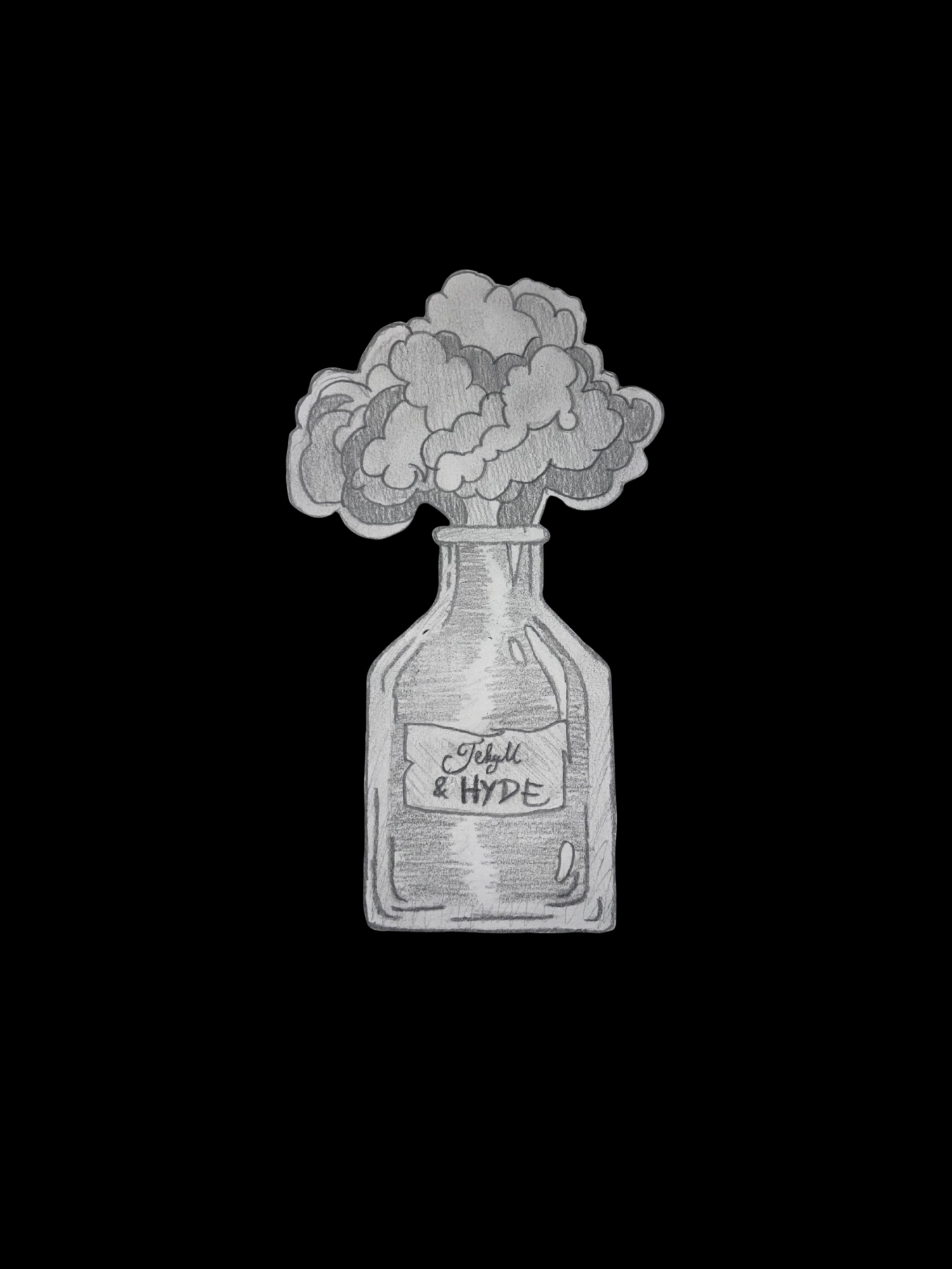
What if the most honest version of yourself is the one you try hardest to hide? This question is at the center of Emmaus High School’s spring performance “Jekyll & Hyde,” and it is an exciting feat to bring the tale to life.
The musical itself was conceived for the stage by Frank Wildhorn and Steve Cuden, adapted from Robert Louis Stevenson’s 1886 Gothic novel “The Strange Case of Dr. Jekyll and Mr. Hyde.” In spite of this story’s age, many of its themes are still extremely relevant to modern-day society and life. EHS’s theater director, Jill Kuebler, found the following themes to be the most deserving of emphasis: mental health, expectations from societal conformity, and social classes.
For a brief synopsis, this is the story of Dr. Henry Jekyll, a young scientist who is sickly fascinated with what he calls the “primitive duality of man — good and evil.” He questions if it is possible to cast out the malevolence from within a person and leave behind only the good.
For an upper-class doctor in London, England, survival demands compliance to societal standards. However, Dr. Jekyll ignores this sentiment after watching his own father descend into madness. He finds himself fixated on the evil that can kill a man from the inside out. A potion of his own invention unleashes a demonic persona that lurks within him, leading to despair and tragedy.
In today’s world, the mysteries of madness have explanations. In fact, mental health is something that is often discussed. The importance of caring for one’s mental health is emphasized, especially for high schoolers navigating through this bizarre world. However, 140 years ago, it was barely addressed. Doctors and specialists played mental disorders off as lunacy or idiocy. They were managed with harsh methods that resembled punishment rather than treatment — to control rather than heal.
Those who struggled with mental disorders had to conceal their hardships from society, and in the musical, Dr. Jekyll is thought to be irrational and senseless for wasting his time trying to help the helpless. Dr. Jekyll’s fear and hatred for the world take the form of the personality, Edward Hyde. Hyde is a sinister, beastly man that succumbs to the temptation of evil and sin. This is a metaphor for the internal malice that is conceived from the suppression of our own fear and hatred. The suppression of Jekyll’s imperfections, for fear of society, makes Mr. Hyde’s existence within Dr. Jekyll inevitable. The compassionate and beloved doctor is transformed into Hyde when he drinks his elixir, opening a Pandora’s box of his darkest desires into his community.
However, a similarity that both Jekyll and Hyde share is their detestation towards the virulent force of society. Jekyll is aware that success and power relies heavily on the necessary evil of popularity and validation. Therefore, when Jekyll is transformed into Hyde, he discovers that he has the ability to carry out all of his evil inclinations without bearing the consequences. Social expectations are accountable for turning man against one another, and in Jekyll’s case, against himself.
The social pressures Dr. Jekyll faces are, in many ways, the pressures we as teenagers still face today. The concept of self-expression and embracing individuality is something that has been heard a high schooler’s entire life. Yet, happiness is still believed to originate from forcing oneself to be someone who they are not. Individuals chase that false image of serenity because it is believed to hold all that one could desire: success, community, fulfillment, satisfaction.
We know that this prospect of orderly compliance is not just applicable to modern times because this Victorian novel exhibits the exact phenomenon. Stevenson shows how, at the time, everyone wore a mask because the consequence of being unique was losing everything. One’s reputation was the most substantial form of currency.
That is why the transformation from Dr. Jekyll to Mr. Hyde is so freeing for Jekyll. The sudden release from a corrupt society allows Dr. Jekyll to become completely opposite from his “normal” self. Hyde’s destruction is unlike anything else, even though he is a piece of Jekyll’s soul, meaning that Hyde was in him all along. This raises a fundamental question: if Dr. Jekyll’s personality is a conventional mask, is Mr. Hyde his true persona?
Self-identity is a struggle for adolescents. In the process of discovering who you are, it is comforting to associate with cliques. Division of classes in society expected the upper class to be prim, proper, and perfect, but they were known to be greedy and ignorant. The lower classes were expected to be barbaric, poor-mannered, and squalid, but they were simply trying to survive. This was the separation of classes. It was who you were and who you always would be. A widespread disease without a cure.
Forbidden romance, a common motif in classic literature, is present in this tale as well. Dr. Jekyll takes an interest in a woman, Lucy Harris, who has been forced to surrender her pride and purity for survival. Both feel a sense of liberation when they are with the other. Lucy feels respected, even loved. Jekyll feels understood and hopeful for humanity. However, they are never able to be together, largely because the union would not be deemed appropriate, but also because Jekyll is already betrothed to another.
Mental health, societal conformity, and social classes are subjects in this story, and in our lives, that beg to be addressed and discussed. Social conformity pressures people to meet the expectations placed upon their specific social class, forcing them to hide mental struggles and hardships. Now, reader, I beg the question that I hope you will find the answer to by going to see EHS’s performance of “Jekyll & Hyde.” Is mankind wicked with a tendency to do good, or is humanity altruistic with a tendency to be bad?
Information regarding ticket reservations can be found at www.eastpennsd.org/ehs.
Categories:
Jekyll & Hyde: Unmasking duality of human nature through EHS spring musical performance
March 2, 2026
More to Discover