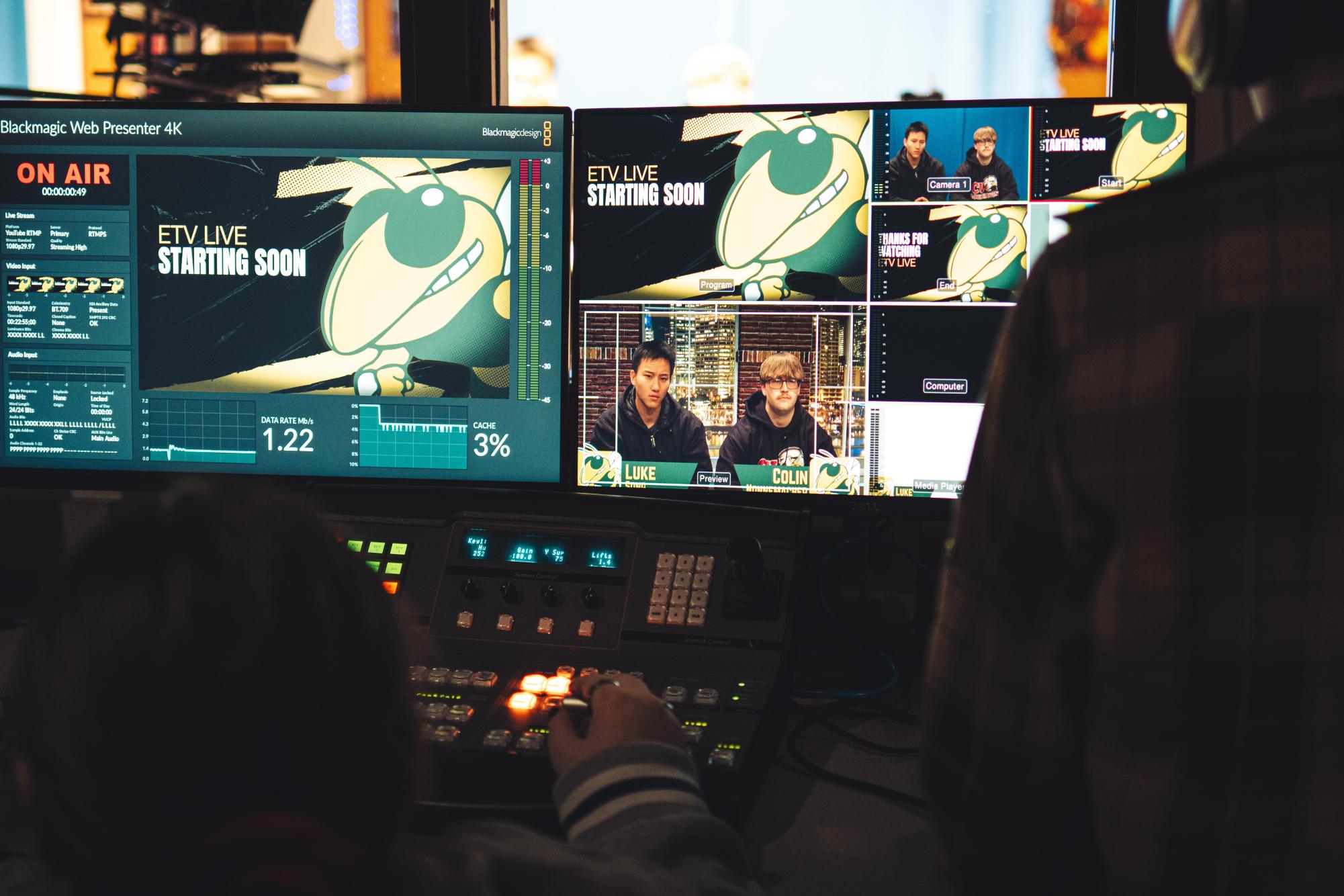

The lights flicker on one by one, flooding the Emmaus TV (ETV) studio in a warm glow. A singular camera remains steady as the teleprompter begins a slow scroll. A student in the corner whispers cues to the two anchors seated in front of a blue background. The anchors fidget with their mics while a crew member aligns them with the center of the camera. Wires shuffle, switchboard blinks, and the director waits patiently to hit the live button. The room stills for a moment as the anchors take a deep breath.
“Three…two…one…” The director says. And just like that, another episode of ETV begins.
At Emmaus High School, ETV is more than weekly announcements; it’s a student-run broadcast built within the school’s Broadcast and Film courses. The program has operated for over 20 years, but its impact remains the same: keeping students informed, involved, and connected.
“ETV is part of the Broadcast and Film three and four courses,” long-time advisor and teacher of all four levels Jill Kuebler said. “Level two students contribute to ETV by creating short segments to air on ETV, and then level three and four actually run the live stream that we put out to the school on Tuesdays through Thursdays every week.”
In addition to the live shows, upper-level students produce the Friday show, which takes on a “news magazine format with different segments,” Kuebler said, written and pitched by the students themselves. They aren’t assigned roles; instead, they take on segments that interest them.
“It’s a lot of work,” Kuebler said. “They have to write [scripts], we film in class, then they edit and submit everything. Whoever’s doing the lead edit has to put it all together on Thursday night and get everything uploaded.”
A typical Friday episode takes around an hour and 15 minutes to write, film, and edit; however, this estimate doesn’t account for technical problems that may arise. Once, the crew suffered mic issues upon mic issues, as they raced to finish the Friday episode in time for the lead editor. It took the entire team to troubleshoot and fix the problem.
“You have to be able to work with other people to be successful in the process,” junior ETV member Bella Nguyen-Horvath said.
For Kuebler, this collaboration is exactly what makes the program meaningful.
“It teaches real-world skills of having to produce something on a timeline, and it emulates a real work environment because we have a certain schedule and certain deadlines that we have to meet,” Kuebler said. “When there are technical issues that arise, we have to figure them out.”
Beyond learning technical and teamwork skills, the show plays a vital role in keeping EHS connected. For many students, ETV is one of the only places where activity dates, club announcements, and school updates are consistently available.
“We get to send out a lot of announcements that students wouldn’t get otherwise,” senior crew member AJ Deneen said. “It’s important to have ETV so that people know what’s happening around the school.”
As the studio lights dim and equipment is rolled back in place, the crew resets, ready to do it all again the next day. For the students who run it, ETV is more than a class requirement; it’s a responsibility, a team, and a space where big ideas turn into something real. And with every “Three…two…one…,” EHS tunes in, watching the work of students who learn, create, and connect their school one broadcast at a time.
Check out The Stinger’s December Print Issue for photos of ETV.