

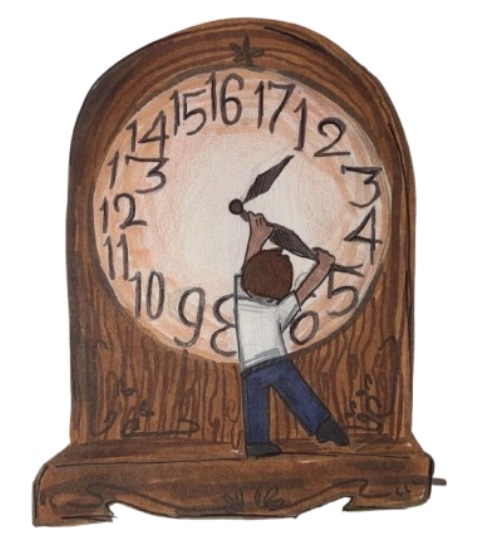
Define a day
When asked what defines a day, some might think of the earth making one full rotation, others might say a period defined by 24 hours. To me, a day can be defined by the multitude of stressors I encounter from the moment I wake up until the moment I pass out from exhaustion. To me, a day is defined by whether or not I manage to accomplish all of the things that I determine to be necessary to do within that day. Frequently, I fail to complete my long to-do list, leading to what feels like a day wasted.
Adding up the hours
It takes around 30 minutes just to get ready for school. On an average school day, I spend eight and a half hours focused on academics from the moment I am picked up to the moment I am dropped off by the bus. During production for the newspaper, I can expect to spend an extra two and a half hours at school. After school, I often spend about an hour working out, along with one to two hours socializing with or taking part in activities with my family. Additionally, I spend about five hours working during weekdays with my seasonal job. On Wednesdays, I participate in 30 minute guitar lessons, which usually occurs after 15 minutes of practicing, and is followed by another 30 minutes of practicing. After that, I spend around one or two hours each day on homework. I then attempt to get eight hours of sleep; however, I am often unable to do so.
No need to grab your calculators, this displays a 30-hour-and-45-minute-packed schedule, which excludes personal hobbies, socializing with friends, eating, driving to and from places, and any other activities that occur daily. Consequently, I have to pick and choose what I do each and every day; choosing between practicing guitar or hanging out with friends, sleeping for a full night, or studying for a big exam. Without a sufficient amount of time in a day, students like me are left overwhelmed and overworked.
Running out of time
With each tick, the clock strikes closer to 12 a.m.; having so much to do and so little time to act, I am left choosing between leaving tasks incomplete or cutting into the next day with yesterday’s problems. This suddenly opens a new problem as days fade into one another; I ask myself, “Do I leave what couldn’t be completed in the day incomplete?” If not, time will eventually catch up with me. I’ll feel burnt out knowing that I will never catch up with time, and I will forever live in the past while trying to resurface in the present.
Suddenly, I find myself awake at night, contemplating past mistakes, and wondering to myself, “Why didn’t I manage my time better throughout my youth?” I understand now why people say time is money, but unlike money, there is never enough time to spend it all correctly.
The ideal day
My ideal day would be 34 hours — with that much time, I would be able to go to school feeling well-rested enough to participate; furthermore, I would feel more energetic in orchestrating The Stinger’s news section. Outside of school, I would be able to get in the guitar practice necessary to continue improving, as well as participate in my guitar lessons. I would have time to work out and spend time with my family, as well as complete any and all homework. Finally, I would be able to get the eight hours of sleep required to have the energy to continue doing this. Additionally, I would have two hours and 15 minutes to participate in hobbies and socialize with my friends throughout the day.
Compromising with the clock
Meeting your own goals for a day can sometimes be impossible, so don’t feel unaccomplished or ashamed for not meeting those expectations. Though the measurements of time can’t be restructured, personal standards could be restructured to better accommodate each individual’s needs. So, set standards that are achievable, take on tasks that are reasonable, and don’t dwell on the past; in this lifetime, there is only the future — so focus on forward momentum.