
As students, we consume hundreds of online articles a year, shortly skimming and grabbing information to copy and paste and forget about instantly once we release Control + V.
Newspaper delivery boys were last seen in a recently released ‘80s movie, and N.Y. subways are haunted by boarded-up newsstands. Usual sights for the older generation are now foreign to our teenage eyes. As we immerse ourselves deeper into the online world, we bear witness to the death of physical media.
While digging deeper into the loss of newspapers and the rise of online journalism, I came across a video from 2009 titled “Prof. Rosental Alves on online media.” Rosental Alves was a professional journalist for 27 years, including seven years as a journalism professor in Brazil, and 23 years as the managing editor of “Jornal do Brasíl”; one of the most important Brazilian newspapers.
The printing press of 1440, often considered the birth of news, revealed that the success of journalism is frequently measured by the audience it captures.
With print media, newspapers could be spread across an entire nation. From then on, the whole world was given instant, in-depth coverage on local and global news. In 1980, The Columbus Dispatch became the first newspaper in the world that could be read online. Now, the news is seen as a disturbance rather than a new-found resource. Spam mail consists of The New York Times’ advertisements and notifications from The Morning Call, while our society blissfully ignores the chaos of the world around us.
The spike in online publishing occurred after the 9/11 terrorist attack. News no longer had to go through days of fact-checking and fine-tuning; timeliness was the main concern. This led to false, rushed, and biased reporting that still affects our news production today. The urgent demand for stories and failure to provide clear information even led to hundreds of online newspapers going
bankrupt.
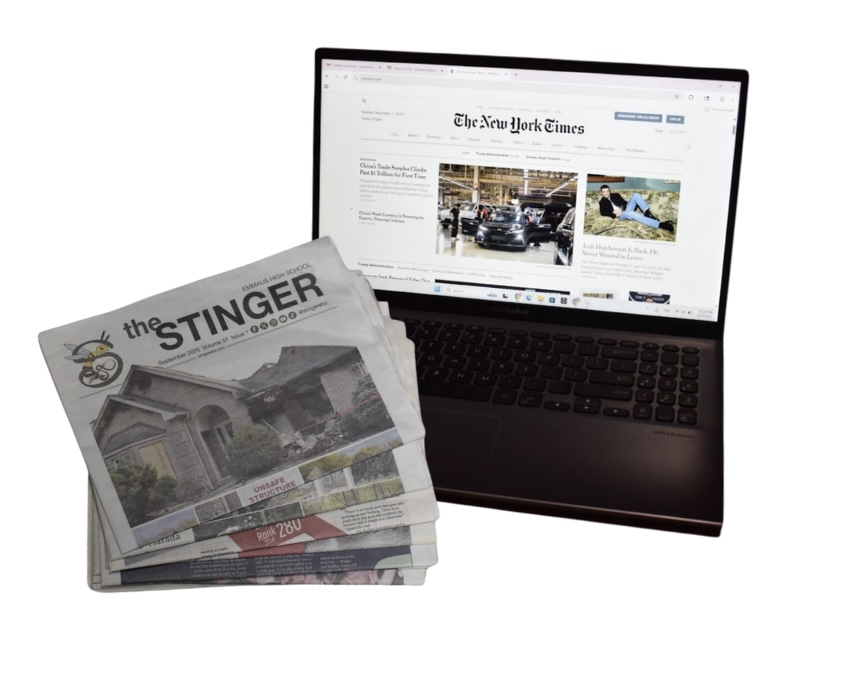
Emmaus High School is lucky enough to continue to print newspapers through The Stinger, while also managing our online presence; many other local high schools only publish online. Even locally, the two most well known newspapers in the Lehigh Valley, The Express-Times, stopped printing in Feb. 2025 and The Morning Call also reduced its print operations.
Now, who am I to pretend that I read a newspaper everyday. I am, however, a fan of nostalgia. Collecting CDs, and vinyl bring back tradition and the permanence of media. Nowadays, teenagers come across so much music in randomized playlists, they forget to listen to the artist’s creation of an album. Eventually moving on to the next trending show, or song until it gets forgotten.
This branches out to news as well, we see so much information about the world’s current state that none of it is processed in our brains, or stored, physically and mentally.
Online journalism is an incredible resource, multimedia aspects really raise news quality. Our free and immediate access to journalism through online is not only enjoyable, but also life saving. However, the line between helpful and damaging was crossed when print journalism began disappearing completely. We began living in an age of skimming and distraction. Our society never sets time aside to appreciate how much knowledge newspapers and magazines have on so many diverse topics.
I am definitely biased, The Stinger has been a part of all of my four years of high school, so I have always interpreted newspapers as a time capsule leading to my passion for print media. On my recent visit to Boston, I searched for a newspaper on every block, so I could not only read local stories, but store it to remember this trip forever. Needless to say, my findings were empty, broken news boxes, and chained up newsstands.