This was previously published in our April 2026 issue.
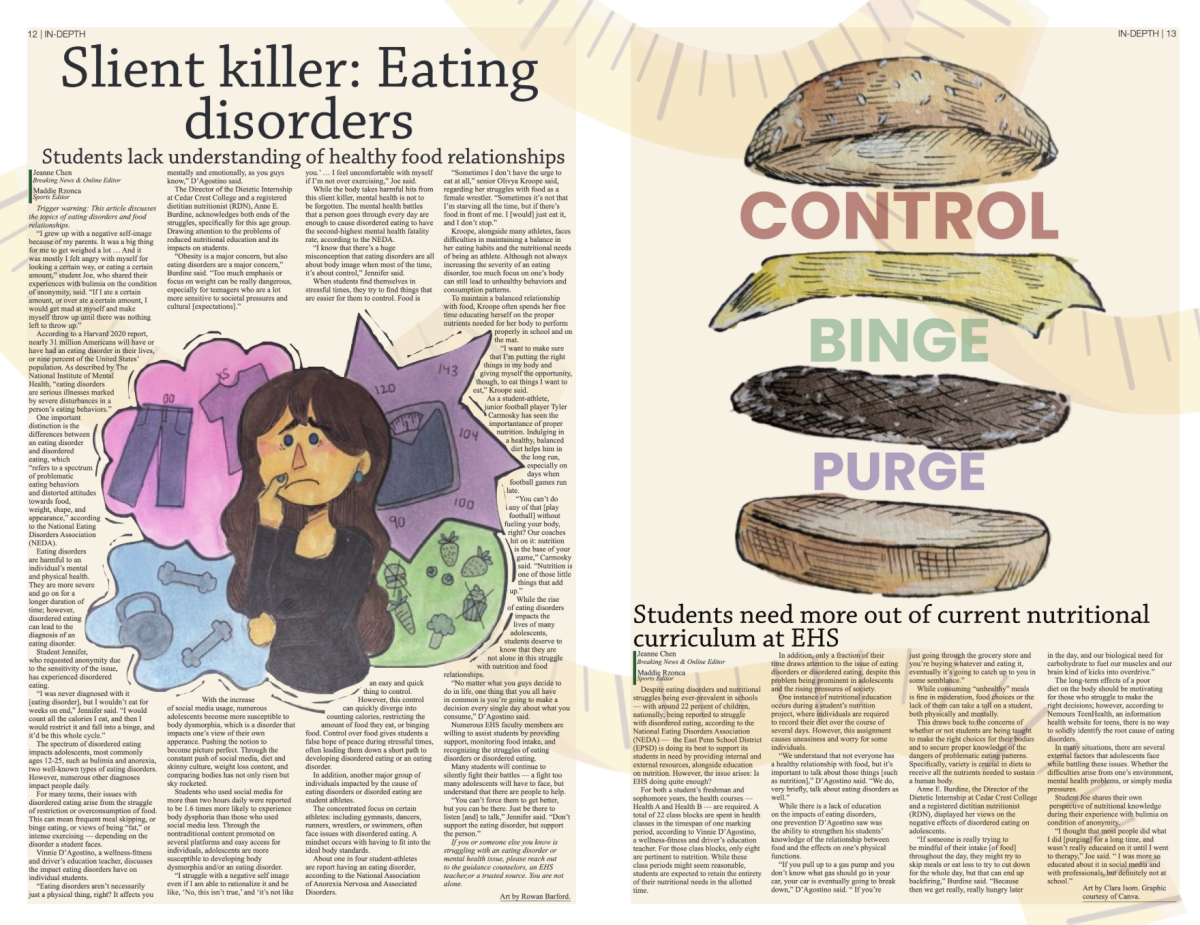
Trigger warning: This article discusses the topics of eating disorders and food relationships.
“I grew up with a negative self-image because of my parents. It was a big thing for me to get weighed a lot … And it was mostly I felt angry with myself for looking a certain way, or eating a certain amount,” student Joe, who shared their experiences with bulimia on the condition of anonymity, said. “If I ate a certain amount, or over ate a certain amount, I would get mad at myself and make myself throw up until there was nothing left to throw up.”
According to a Harvard 2020 report, nearly 31 million Americans will have or have had an eating disorder in their lives, or nine percent of the United States’ population. As described by The National Institute of Mental Health, “eating disorders are serious illnesses marked by severe disturbances in a person’s eating behaviors.”
One important distinction is the differences between an eating disorder and disordered eating, which “refers to a spectrum of problematic eating behaviors and distorted attitudes towards food, weight, shape, and appearance,” according to the National Eating Disorders Association (NEDA).
Eating disorders are harmful to an individual’s mental and physical health. They are more severe and go on for a longer duration of
time; however, disordered eating can lead to the diagnosis of an eating disorder.
Student Jennifer, who requested anonymity due to the sensitivity of the issue, has experienced disordered eating.
“I was never diagnosed with it [eating disorder], but I wouldn’t eat for weeks on end,” Jennifer said. “I would count all the calories I eat, and then I would restrict it and fall into a binge, and it’d be this whole cycle.”
The spectrum of disordered eating impacts adolescents, most commonly ages 12-25, such as bulimia and anorexia, two well-known types of eating disorders. However, numerous other diagnoses impact people daily.
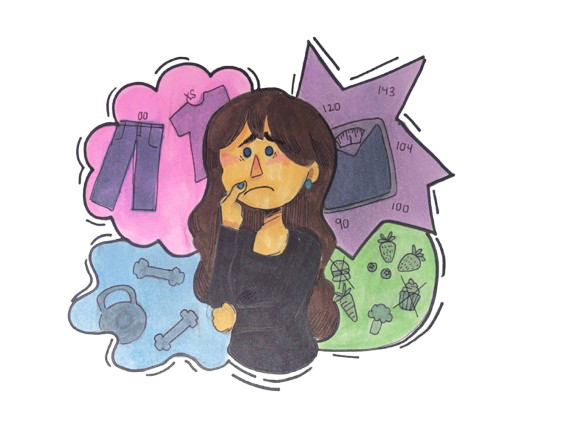
For many teens, their issues with disordered eating arise from the struggle of restriction or overconsumption of food. This can mean frequent meal skipping, or binge eating, or views of being “fat,” or intense exercising — depending on the disorder a student faces.
Vinnie D’Agostino, a wellness-fitness and driver’s education teacher, discusses the impact eating disorders have on individual students.
“Eating disorders aren’t necessarily just a physical thing, right? It affects you mentally and emotionally, as you guys
know,” D’Agostino said.
The Director of the Dietetic Internship at Cedar Crest College and a registered dietitian nutritionist (RDN), Anne E. Burdine, acknowledges both ends of the struggles, specifically for this age group. Drawing attention to the problems of reduced nutritional education and its impacts on students.
“Obesity is a major concern, but also eating disorders are a major concern,” Burdine said. “Too much emphasis or focus on weight can be really dangerous, especially for teenagers who are a lot more sensitive to societal pressures and cultural [expectations].”
With the increase of social media usage, numerous adolescents become more susceptible to body dysmorphia, which is a disorder that impacts one’s view of their own apperance. Pushing the notion to become picture perfect. Through the constant push of social media, diet and skinny culture, weight loss content, and comparing bodies has not only risen but sky rocketed.
Students who used social media for more than two hours daily were reported to be 1.6 times more likely to experience body dysphoria than those who used social media less. Through the nontraditional content promoted on several platforms and easy access for individuals, adolescents are more susceptible to developing body dysmorphia and/or an eating disorder.
“I struggle with a negative self image even if I am able to rationalize it and be like, ‘No, this isn’t true,’ and ‘it’s not like you.’ … I feel uncomfortable with myself if I’m not over exercising,” Joe said.
While the body takes harmful hits from this silent killer, mental health is not to be forgotten. The mental health battles that a person goes through every day are enough to cause disordered eating to have the second-highest mental health fatality rate, according to the NEDA.
“I know that there’s a huge misconception that eating disorders are all about body image when most of the time, it’s about control,” Jennifer said.
When students find themselves in stressful times, they try to find things that are easier for them to control. Food is an easy and quick thing to control.
However, this control can quickly diverge into counting calories, restricting the amount of food they eat, or binging food. Control over food gives students a false hope of peace during stressful times, often leading them down a short path to developing disordered eating or an eating disorder.
In addition, another major group of individuals impacted by the cause of eating disorders or disordered eating are student athletes. The concentrated focus on certain athletes: including gymnasts, dancers, runners, wrestlers, or swimmers, often face issues with disordered eating. A mindset occurs with having to fit into the ideal body standards.
About one in four student-athletes are report having an eating disorder, according to the National Association of Anorexia Nervosa and Associated Disorders.
“Sometimes I don’t have the urge to eat at all,” senior Olivya Kroope said, regarding her struggles with food as a female wrestler. “Sometimes it’s not that I’m starving all the time, but if there’s food in front of me. I [would] just eat it, and I don’t stop.”
Kroope, alongside many athletes, faces difficulties in maintaining a balance in her eating habits and the nutritional needs of being an athlete. Although not always increasing the severity of an eating disorder, too much focus on one’s body can still lead to unhealthy behaviors and consumption patterns.
To maintain a balanced relationship with food, Kroope often spends her free time educating herself on the proper nutrients needed for her body to perform properly in school and on the mat.
“I want to make sure that I’m putting the right things in my body and giving myself the opportunity, though, to eat things I want to
eat,” Kroope said.
As a student-athlete, junior football player Tyler Carmosky has seen the importance of proper nutrition. Indulging in a healthy, balanced diet helps him in the long run, especially on days when football games run late.
“You can’t do any of that [play football] without fueling your body, right? Our coaches hit on it: nutrition is the base of your game,” Carmosky said. “Nutrition is one of those little things that add up.”
While the rise of eating disorders impacts the lives of many adolescents, students deserve to know that they are not alone in this struggle with nutrition and food relationships.
“No matter what you guys decide to do in life, one thing that you all have in common is you’re going to make a decision every single day about what you consume,” D’Agostino said.
Numerous EHS faculty members are willing to assist students by providing support, monitoring food intake, and recognizing the struggles of eating disorders or disordered eating.
Many students will continue to silently fight their battles — a fight too many adolescents will have to face, but understand that there are people to help.
“You can’t force them to get better, but you can be there. Just be there to listen [and] to talk,” Jennifer said. “Don’t support the eating disorder, but support the person.”
If you or someone else you know is struggling with an eating disorder or mental health issue, please reach out to the guidance counselors, an EHS teacher, or a trusted source. You are not alone.