In one corner of the classroom, Ellie finishes her assignment early. She patiently looks around, searching for another task to complete. A few seats over, Dan is still working through the first question. Between them, Chris is working at a steady pace, about halfway through the work.
They’re in the same course, learning the same material, completing the same assignments — but they are not necessarily at the same level.
Although Ellie, Dan, and Chris may not be real students, scenes like this have become more common. Just three years after the implementation of detracking in Emmaus High School, the policy continues to spark debate in the school community.
PRIOR TO THE CHANGE
Just a few years ago, before detracking, students at EHS were placed into four different
academic tracks: General Preparatory (GP), College Preparatory (CP), Honors, or Advanced Placement (AP). Students were placed or could choose between these courses based on their academic needs, with GP often providing additional support and a slower pace, while the higher-level courses moved more quickly and required more independent work.
However, the administration of the East Penn School District noticed that the distribution of student groups was imbalanced.
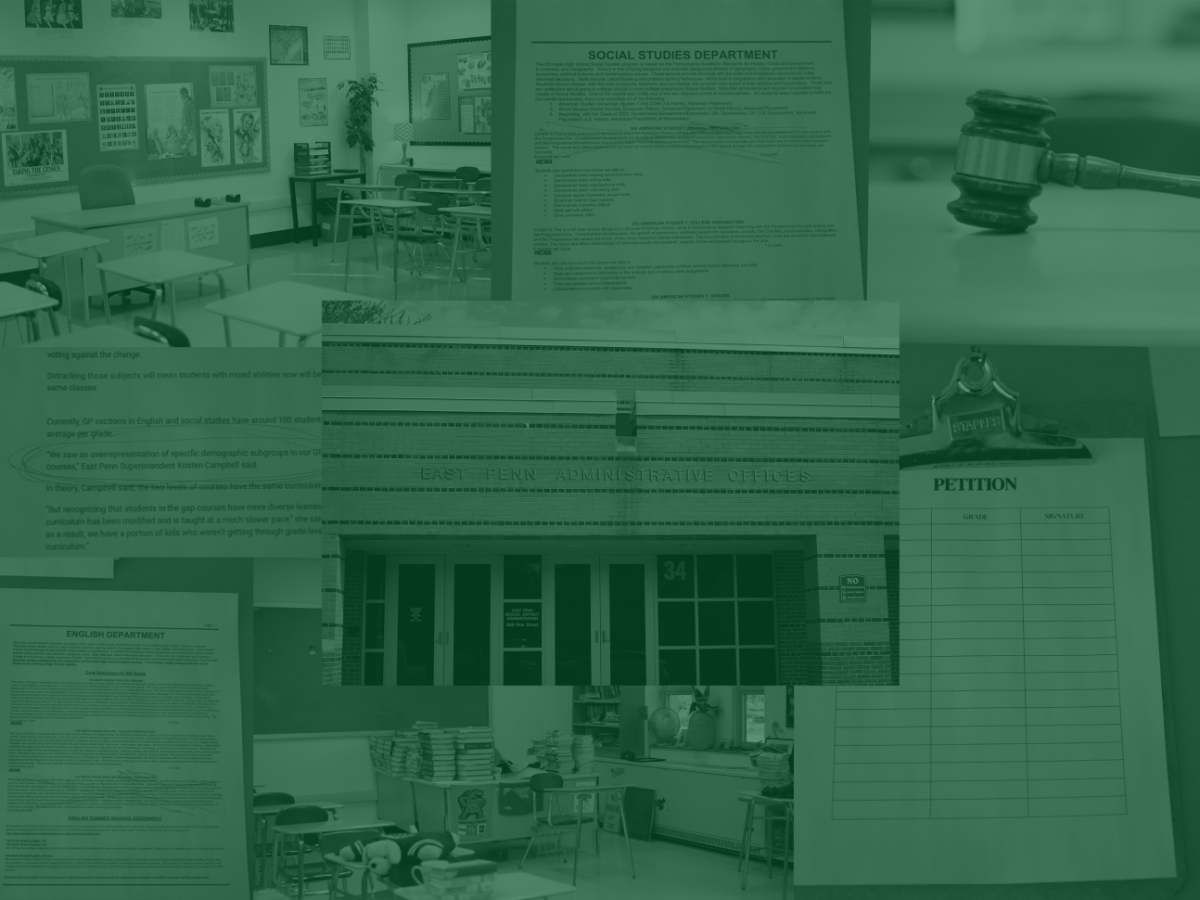
In a statement to Lehigh Valley News, EPSD Superintendent Kristen Campbell said, “We saw an overrepresentation of specific demographic subgroups in our GP-level courses.”
Accompanying a slideshow shown at school board meetings, the quote highlights the racial breakdown of students within certain class tracks. The data showed that a disproportionate number of students in minority groups were enrolled in the lower tracks of GP and CP.
Detracking, in part, was intended to address this imbalance by placing students in a more diverse learning environment.
At its core, detracking changes how students are grouped. Detracking removed the GP option, combining GP and CP students into a shared “on-level” class, creating a wider range of skill levels within a single class. Meanwhile, honors and AP remained the same.
For the 2023-24 school year, detracking was implemented into the English and social studies classes. The freshman class of 2027 was the first to face the change. Detracking followed behind them in a roll-out
process, leaving the current senior class of 2026 as the last class with the choice to still select GP-level classes in English and social studies.
HOW IT ALL STARTED
Leading up to the East Penn School Board’s decision to approve detracking, teachers and students spoke at school board meetings, raising concerns about both the speed of the rollout and the lack of input from those directly affected.
The English department took to the discussion by drafting a letter outlining their concerns. English Department Chair Justine Frantzen said the letter was intended to ensure teachers had a voice in the process.
“The letter was written because we did not feel like we were part of the conversation when detracking came about,” Frantzen said. “We just wanted to make sure that we as teachers, and students alsom had a seat at the table to express concerns.”
John Gallagher, former EHS social studies teacher, expressed that many teachers were not necessarily opposed to detracking itself, but wanted more time to evaluate how it would work.
“All we wanted was for more time to look at this…Gallagher said. It was not that we were against [detracking], but let’s look at this some more, and let’s talk about it.”
Teachers further questioned whether the district had fully considered the realities of implementing such a significant change in large, modern classrooms.
“At that meeting, the concerns of our colleagues [were that the board] didn’t talk to us,” Gallagher said. “Come on in [our classrooms]. See what we do, and see if this is really going to work.”
Supporters of detracking, including some board members, argued that similar systems had worked in the past and could better prepare students overall.
“I remember in [my] high school…it was a one-track [system]…” former school board member Allan Byrd said. “It was pushed to prepare you, whether you were going to college or you were going to go to just have a job…there wasn’t a separation. I mean, that’s 60 years ago.” Byrd attended South French Broad High School in North Carolina.
Some teachers pushed back on those comparisons.
“There was the comments made by the school board about how people had learned in a one-room schoolhouse,” English teacher Denise Reaman said. “I found that to be rather insensitive, because you cannot compare a building with nearly 3000 students to a one-room schoolhouse. This is not the Mennonite community.”
Students also played an important role in the discussion. Some raised concerns about how detracking might affect their learning, while others were active in sharing unheard peer perspectives.
Cyan Kvacky, former EHS student, during her senior year spoke about the potential impact on students, particularly for those entering high school under this newly developed system. At the same time, Madison Shelton, another former EHS student, spoke with dozens of students and collected 337 signatures for a petition she had organized against the proposal to detrack the high school.
“I wanted to know how [students] felt about detracking. If they knew about it even to begin with, because again this is such a quick turnaround,” Shelton said. “Half the people I talked to didn’t even know what was happening.”
Although at numerous school board meetings, arguments against the policy were allowed, some members felt surprised by the backlash it created.
“We had a great, interesting teacher’s demonstration who didn’t want [detracking], which kind of shocked me…and they said, ‘Well, it’s going to take more time. It’s going to take much prep work because some students can’t keep up,’ and it was all kinds of excuses,” Byrd said. “My answer was, we need to give the students the best we can, yet offer to prepare them for their future, and we shouldn’t be giving something that’s not gonna help them.”
Through a 6-3 vote, the East Penn School Board ultimately approved detracking in December 2022. Board members Alisa Bowman, Allan Byrd, Paul Champagne, Joshua Levinson, Adam Smith, and William Whitney voted in favor, while Jennifer Bowen, Michael Felegy, and Jeffrey Jankowski voted against.
The Stinger reached out to Jankowski but did not get a reply.
Superintendent Campbell also did not respond to questions at the time of publishing.
Supporters, especially those on the school board, argued that detracking would push students academically and help prepare them for their futures.
“I felt that a General [Prep] course was not taking care of the masses and not challenging the students,” Byrd said. “They could go into a more Advanced Prep or more challenging course [and it] would be more productive…they’d be more prepared to go out into the real world.”
INSIDE THE CLASSROOM
Now in its third year, detracking’s impact is visible in everyday classrooms. Compared to classes before detracking, there is now more of a spectrum of learning levels.
“Within one classroom, there’s more levels whereas [students] were more similar per classroom before,” English teacher Derek Grabfelder stated.
This range can make it challenging to design lessons that meet everyone’s needs at the same time.
“You have students who probably could do honors, but maybe don’t want to do the class, and you [also] have students on a second-grade learning level,” Social Studies department chair and teacher Melissa Moxley said. “To enrich their content is…differentiation of trying to give each student a level which is appropriate for them.”
To adjust, EHS educators have had to altar their instruction, often providing different levels of support within the same assignment.
“So we had to adjust to a lot of students [with] different executive functioning skills. Our instruction has had to be a lot more intentional, and a lot more guided, and a lot more structured,” Moxley said.
In some cases, it can be difficult to balance the needs of students who move quickly through material with those who need more time. Students who finish early may feel unchallenged, while others may feel overwhelmed trying to keep up with their peers.
“If [the students] already feel that they’ve accomplished the task, they’ve mastered the skill, why are they waiting for people who need more time to be able to complete the same assignment or a modified assignment?” Reaman said.
A positive outcome of the detracked on-level classes is that they are smaller, which allows for more individual attention. Students were also redistributed into higher levels, which can encourage academic growth and offer the opportunity for students to rise to a new challenge.
TEACHERS OFF THE RECORD
While half of the teachers approached for an interview regarding their experiences with detracking agreed, the other half, and many other teachers across the school were more hesitant.
Some declined to be interviewed, while others chose to share their perspectives anonymously, reflecting the sensitivity that surrounds this topic till this day.
In an anonymous survey sent to 88 teachers across the four core subjects at EHS — English, social studies, math, and science — only 29 teachers opted to participate, and responses illuminated a wide range of opinions.
While 13.7 percent of respondents showed some level of favorability towards detracking as a concept, the remaining 86.3 percent of teachers showed a level of unfavorability. Several described the policy as something that “looks good on paper,” but does not translate well to real classrooms.
“Philosophically, I can understand how it might elevate learning and expectations for some students,” one teacher wrote. “However, the students who seriously benefit from having a slower paced curriculum due to IEP’s (mostly) are not rising to the challenge or even getting extra support.”
Regarding the redistribution of students, there were mixed opinions on the effects of placing students into more advanced courses than they previously would have enrolled in. Some felt that detracking provides a vital challenge for students, while others feel that detracking lowers the challenge.
“The students who don’t need significant support are often lost in the crowd, provided with work that does not challenge them in the way that would be more necessary for growth,” another teacher said.
When asked how effective they felt the district’s implementation of detracking was on a scale of 1-10, with 10 being very effective, 92.3 percent of respondents reported that the implementation was ineffective. Specifically, of the twenty six teachers that responded to this particular question,, 38.5 percent felt that the district’s method was extremely ineffective.
In the free response section regarding the district’s implementation of detracking, 9 out of 13 teachers described the rollout process as rushed, with limited time for preparation and little training provided.
“It normally takes three to five years to implement this change,” one teacher wrote. “It was done in a few months without proper consideration of the ramifications of the actions.”
CONCLUSION
Three years after detracking reshaped Emmaus High School, opinions on the topic remain divided. Supporters continue to view it as a step toward greater equity and opportunity, while critics argue that it has made teaching more difficult and learning less consistent for students at different levels.
“We want nothing but success for every single student, and anything that works against that, we are wary of and don’t want that to happen,” Gallagher said.
As detracking continues its implementation in the school, educators and administrators seek to further promote equity in education by putting the needs of students at the heart of every decision.
“I believe that the school board understands, and some of the people who come [after] me have the same vision that education is the most important thing for our students and our community,” Byrd said. “It is our job and our duty to ensure that our students have the access to the best education that we can afford.”
Controversy aside, both the East Penn administration and its teachers are fighting for what they believe is best for students like Ellie, Dan, and Chris.