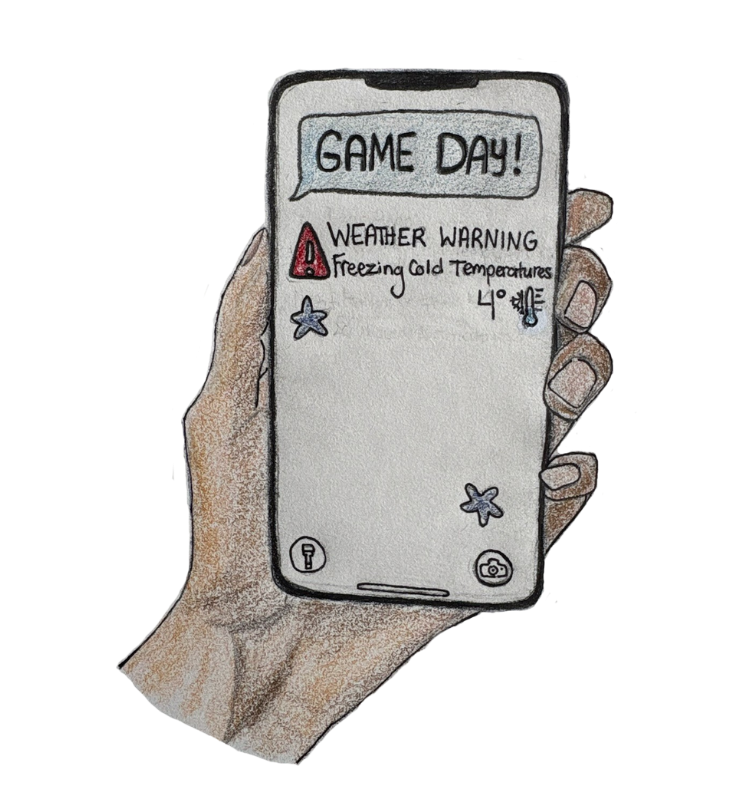
This was previously published in our April 2026 issue.
Additional Reporting by Emily Grabinski
Day 1: Rush commences
It’s Sunday morning, the first day of a long week of rushing. I snap open a Red Bull, the necessary boost of energy for the long days and nights ahead. I throw on my perfectly curated outfit I planned the night before, a blend of personality and sophistication. I prepare myself for the first three days, which are a consistent cycle of “Meet & Greets” and getting a feel for each sorority.
Day 2 & 3
Classes have started again, but rush doesn’t begin until 8 p.m., when the last class lets out. Open Houses begin: the whole day leaves me anticipating the socialization ahead, and how I will present who I really am in hopes of getting chosen by my favorite sorority.
Day 4
Time moves faster, and the pressure increases with the Sisterhood rounds. 30-minute interviews for members to portray the best version of themselves, and their best outfit. Today is the day I’ve been waiting for. The day where I get to not only show who I am through my dress and heels, but also through my words.
Day 5
Today is filled with explanations about the different charities each sorority and fraternity proudly represents — known as a philanthropy. It is important for me to pay attention because I want to pick a sorority that best fits me and the philanthropy that aligns with my interests.
Day 6
The week continues on with the preference round, the deciding moment where I get to pick my favorite sororities and see if they pick me too. I start the day by visiting my top two houses where I have deep conversations with them about sisterhood, which is what guided me to pick my favorite sorority. I end the day with filling out my membership recruitment acceptance binding agreement where I rank my top options.
Day 7
Finally, my hard work comes to a close as I receive my sealed BID day card (a formal invitation extended by a fraternity or sorority to a potential new member to join their chapter) that has the power to change my life. I shake as I open the flimsy envelope and see the three letters, “AKA”, that change my life forever. I run to my fellow sisters and tears run down our faces. We take photos with the biggest smiles and the huge letters that represent our sorority. I end the day by being welcomed in a new pledge class.
Each chapter, filled with the excitement of new experiences that just opened up to me for the next four years. Greek life Rush, also known as recruitment, is the process chapters take to find the best members for their organizations. Although it is a complex experience, it is necessary for matching new members to their future homes.
Makenzie Monfredi, Emmaus High School 2024 graduate and Duquesne University sophomore, felt uncertainty about meeting people upon entering college. Monfredi was focused on her academics, and being a nursing major, she knew it would be challenging. She was not only nervous about juggling all the commitments that come with being in a sorority, but balancing the demand of the nursing program.
Monfredi found herself feeling homesick throughout her first semester at Duquesne, which led her to the decision to rush. After her freshman year roommate rushed, it seemed like the perfect opportunity to gain new connections.

“This is college. You’re supposed to meet new friends and get out of your comfort zone. So, I was very nervous about doing it, but I signed up. In the back of my head, I told myself if it’s not for me, I don’t have to continue with it right away,” Monfredi said. “I made the right decision because I can tell there was a big change in my college experience.”
Feeling homesick can be overwhelming, but for some, the desire to find new friends and people outweighs the nerves of it all.
Mandy Barnes, EHS graduate attending the University of Oklahoma pursuing a major in communications and a minor in psychology, joined a sorority. The Xi chapter of Alpha Omicron Pi is built upon friendship, sincerity, and service, with a focus on lifelong friendships. Barnes used her sorority as a way to get over the homesick feeling and meet new people.
“You want to find your true home and where you really belong,” Barnes said.
Panhellenic recruitment, the official term for rush, is a welcoming, high-energy, fast-paced introduction to fraternity and sorority life. It exposes potential new members (PNMs) to the true dopamine rush of Greek life. Students experience the unstoppable force that are fraternities and sororities.
Molly O’Conner, EHS graduate and former president of Penn State University’s (PSU) sorority, Alpha Phi Gamma Rho has intrique details about the rush process due to her elevated status in the sorority.
“If you have classes, especially later in the day, you can’t really go to it. Our call time to the house was 4:00 p.m. Some days I had class till 5 p.m.,” O’Conner said. “It was a great opportunity to watch it unfold and see all the new members that we got, and be very proud of myself for all the work I put in for weeks. It was a lot of work, and I don’t really know necessarily if I would do it again, just because it took a lot out of me for 14 days.”
Recruitment can be stressful for those running the event as well, especially for those who create the magic of rush through the theme selections, decorations, and placement. Generally the presidents of each of the fraternities and sororities would come together behind the scenes over long nights to create unforgettable experiences for PNMs.
“I barely slept. You get sick; you get run down; you just get exhausted. And although the outcome was very good, and I was very proud of myself and my recruitment team that worked with me, it was a lot of pressure and high demand and exhaustion,” O’Conner said. “But I love being involved. I loved every second of doing all the behind the scenes work.”
Many northern colleges rush in the spring rather than the fall, allowing students to find friends outside of Greek life and settle into college life prior to rush. Having the first semester to adjust allows students to determine if they really want to rush or not, with no pressure and less stress than being thrown right into it during the fall semester.
Despite many similarities, Greek life for southern schools functions differently due to many factors such as more intense rushes, parties, and philanthropic events. As seen on social media, many students participating in rush in the south have brand-name clothing, expensive jewelry, and are required to be with the newest trends.
Barnes recalls her rush experience at Oklahoma being draining but rewarding.
“They [members of the sorority] show you a video or presentation about what the sorority supports because each one has a different philanthropy. It is very mentally draining because you’re talking all day long,” Barnes said. “After that, you rank your top five, and that’s when you have the sisterhood round.”
As seen on Instagram and TikTok, the image of southern Greek life portrays a central focus on the social scene. In recent years, a migration of students in northern state to SEC schools has increased enrollment numbers significantly. This has allowed for more student interaction with social media creating a pool for major misconceptions.
In a study, Sophia Compton, a business reporter covering finance and tourism at Fox News Digital, reports that Southeastern Conference (SEC) schools saw a 91 percent increase in students from northeastern states between 2014 and 2023.
Lila Schneider, EHS graduate attending the College of Charleston (CofC), is a part of the Alpha Kappa Chapter of the Kappa Alpha Pi pre-law sorority. Schneider is majoring in political science and music and has settled into southern Greek life recognizing how misconceptions are easily formed about sorority life.
“A super common misconception is that you have to look a certain way and come from a lot of money. At least in my small, little liberal arts college, that couldn’t be any further from the truth,” Schneider said.
Lack of diversity, though still an issue in Greek life, is beginning to see significant changes. A focal point of many campuses now,
Schneider recognizes how a lack of diversity and incorrect stereotypes of Greek life can have an impact on people’s involvement.
“We have people from all over the world, all different cultures, and socioeconomic backgrounds that participate in Greek life. I’m grateful that this misconception does not apply to my college as I know in most areas of the south it does,” Schneider said.
In recent years, universities have moved to maintain a strict anti-racism campus, with the first school being Oberlin College in Ohio. Recognized as the first college to pass a resolution in 1835, the school authorized the admission of students despite their race. Now,
The University of Pennsylvania is one of the many schools with its own anti-racist working group. In the south, Clemson University has implemented several reforms as well to address racism and promote inclusivity. One such way was renaming its honors college to remove John C. Calhoun, a prominent slavery supporter.
Whether or not these reforms are 100 percent effective is impossible to know, but a movement towards inclusive, multiracial sororities and fraternities signifies growth.
Nick Velde, EHS graduate and PSU senior, noticed those around him assuming that because they are not a part of a fraternity, he does not like them- though this is opposite of the truth.
“I still want to talk to [everyone]. Just because I’m in a frat, doesn’t mean I’m not interested in talking to you,” Velde said.
Another misconception about Greek life is that people are paying for friendship rather than wanting a genuine relationship, yet Greek life members disagree. Sororities and fraternities are just one way to meet new people and friends, a major part of the college experience.
Unfortunately, a part of the college experience is the act of hazing. Under the microscope in terms of hazing, Greek life implemented new protocols and regulations that have influenced some students’ decision to join Greek life.
The first recorded incident of hazing involving sexual abuse occurred in 1983. Hazing has become a key term in Greek life, which is defined as any humiliating, degrading, abusive, or dangerous activity expected of someone joining a group, regardless of their willingness to participate. This process comes in a spectrum with high-frequency cases like intimidation going unrecognized, while lower-frequency cases of harassment and violence are recognized but go unreported.
“Ten years ago, Tim Piazza died from hazing [while participating in rush], which basically sent Penn State into bylaw changes around Greek life, so, now Greek life is still very heavy at Penn State, but it’s looked down upon by the university,” O’Conner said.
After too many years of incidents, colleges and universities have made hazing prevention a priority — whether it is part of a leadership role, how to report it, or how to get more information from the university.
Bennett Sanborn, the current Panhellenic president at the COfC and previous Harm Reduction Vice President of Zeta Alpha, works with nine other girls on her council to create the safest and most organized environment.
“We [the Panhellenic Council] do all things from planning events in philanthropy, education, Diversity Equity Inclusion Belonging, and general programming events all the way to recruitment,” Sanborn said.
In her prior role as vice president of harm reduction, Sanborn was in charge of planning events, contracts, and ensuring risk management amongst their events for Zeta Alpha. She was in charge of any standard issues and conducted hearings along with investigations. Sanborn also worked alongside national chapters to do anti-hazing initiatives and alcohol awareness.
“Immediately after recruitment ended, we had an alcohol awareness workshop where we had nationals fly in,” Sanborn said, “and learn the proper ways of what to do in all the aspects around alcohol.”
Fraternities and sororities mix frequently to facilitate the sister/brother relationship through joint parties and philanthropic events. After a light was shined on fraternities for hazing, sororities increased their guidelines and followed through with their protocols.
Logan Rutter, Vice President of Education on the Interfraternity Council (IFC) of CofC and member of Kappa Sigma, has seen anti-hazing awareness brought to the fraternities at CofC.
“At the beginning, when you’re registering to rush, it outlines what hazing is and what the consequences are. It also states it is not accepted; we’re not doing that sort of thing,” Rutter said.
At convocation, the fraternities have their director, Virginia Felton, go over the definition of hazing. She reiterates what all the PNMs agreed to regarding anti-hazing and tells them to report anything and to just speak up.
“They brought out the mother of a student who passed away due to a hazing incident at another university,” Rutter said. “She told the story of what happened, just to bring a level of reality into the situation, so the guys can understand what the consequences are aside from just the legal obligation.”
Many colleges and universities have reformed their hazing education in relation to Greek life in order to ensure a safer environment for all students. Still, a stereotype remains because of hazing incidents and the party culture associated with Greek life.
“All of us want to get rid of a lot of the negative connotations behind Greek life. It’s definitely a big issue here at CofC,” Rutter said.
Many people hear by word of mouth about Greek life from friends and family, but in reality, Greek life is different at every school. Rutter acknowledges that even with educational activities, incidents still happen, but with more advocacy and education, the amount of hazing can continue to be reduced.
Sandborn has noticed the effect of the anti-hazing educational requirements for PNMs and reflects on the reduction of hazing.
“During my time within Panhellenic, we have not dealt with a hazing incident yet,” Sanborn said. “We have not dealt with hazing incidents within our chapters in a long time, which is wonderful.”
The move towards less hazing in colleges and universities all over the world, starts with educational efforts made individually at these institutions. It is impossible to erase the past damage already done by future awareness and prevention, but it has impacted the number of future incidents. Greek life has continued to improve over the years with more awareness of hazing, prevention, and new philanthropic opportunities.
Today, across 800 college campuses, there are about 750,000 students involved in Greek life. Many students from EHS join Greek life whether they originally intended to or not, making it a huge part of EHS alumni’s post-high school experience.
“If you have a reason to be interested at all, or even if you’re not, forget everything you’ve heard before and show up,” Rutter said. “Be yourself and just see how it goes.”